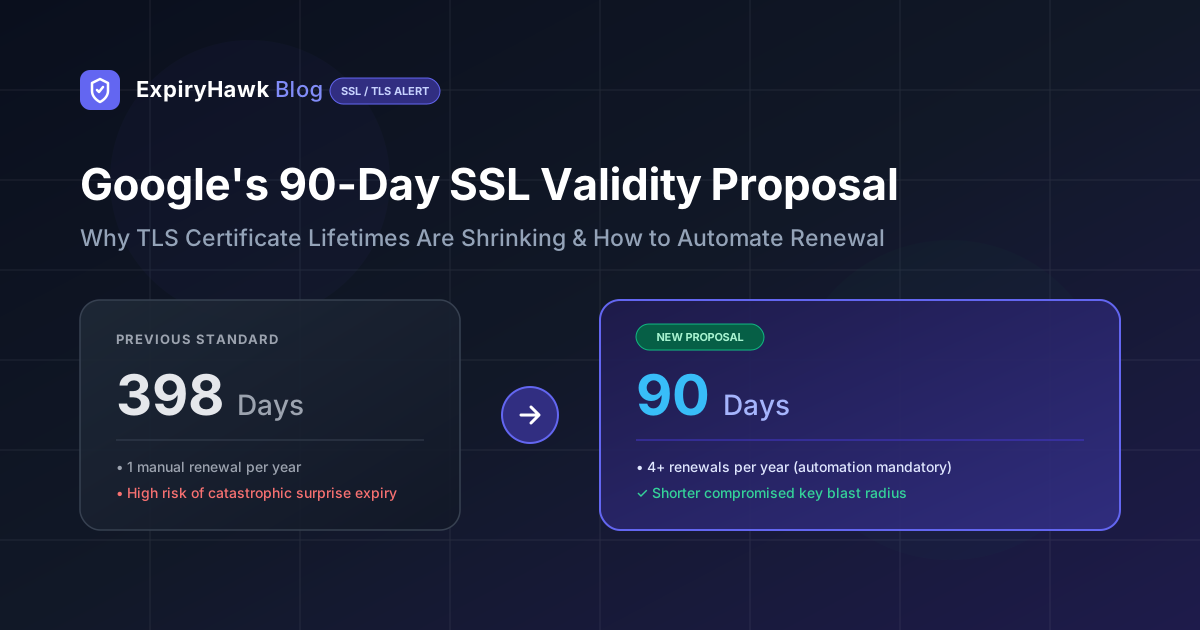
The web PKI (Public Key Infrastructure) ecosystem is standing on the precipice of its most significant shift in years. In its roadmap document titled "Moving Forward, Together", the Google Chrome Security Team announced their intent to reduce the maximum allowed validity period of publicly trusted TLS certificates from 398 days down to 90 days.
For DevOps engineers, site reliability teams, and sysadmins, this transition represents a fundamental paradigm shift: manual certificate management is officially obsolete.
In this guide, we break down why Google is driving this change, what it means for your infrastructure, and how you can prepare your systems today.
The Historical Shrink of TLS Lifetimes#
Certificate lifetimes have been steadily shrinking for over a decade. Each reduction was met with industry pushback, followed by rapid adaptation and an overall stronger security baseline for the global internet.
| Era | Maximum Validity | Primary Renewal Method | Failure Impact |
|---|---|---|---|
| Pre-2015 | 5 Years (1825 Days) | Manual spreadsheets | Forgotten credentials, silent catastrophic outages |
| 2015 - 2018 | 3 Years (1095 Days) | Manual procurement | High risk when primary admins changed jobs |
| 2018 - 2020 | 2 Years (825 Days) | Manual + Early ACME | Increasing renewal frequency |
| 2020 - 2025 | 1 Year (398 Days) | Mixed manual & ACME | 1 renewal per year per certificate |
| Upcoming Standard | 90 Days (or 45 Days) | Automated ACME Only | 4+ renewals/year; manual management impossible |
Why Is Google Pushing for 90-Day Certificates?#
While 90 days may sound aggressive if you are accustomed to annual renewals, the cryptographic arguments behind the proposal are compelling:
1. Minimizing the Blast Radius of Compromised Keys#
If a server's private key is leaked or compromised via memory injection, backup exposures, or internal breach, an attacker can impersonate that server until the certificate expires. With a 398-day lifetime, that gives an adversary up to 13 months of exploitation window. With 90 days, that exposure window shrinks by over 75%.
2. Revocation is Fundamentally Broken#
In theory, compromised certificates are supposed to be revoked via CRLs (Certificate Revocation Lists) or OCSP (Online Certificate Status Protocol). In practice, revocation mechanisms have major flaws:
- Browsers frequently implement OCSP soft-fail, ignoring timeout errors to avoid blocking page loads.
- CRLs can grow prohibitively large and consume significant bandwidth.
- OCSP leaks user browsing habits to CAs, creating privacy concerns.
By shrinking certificate lifetimes to 90 days (and eventually 45 days), the web relies less on broken revocation mechanisms and more on natural, rapid certificate expiration.
3. Post-Quantum Cryptographic Agility#
As quantum computing algorithms advance, the cryptographic community will need to transition millions of certificates to quantum-resistant algorithms (such as ML-KEM and SLH-DSA). Organizations that have built automated pipelines capable of rotating certificates every month can transition crypto algorithms seamlessly overnight.
The Operational Challenge: The 4x Multiplier#
Let's look at the numbers. Consider a mid-sized engineering team managing:
- 15 public web services & APIs
- 10 staging & development environments
- 5 mail, VPN, and internal microservice endpoints
Under the 398-day rule, that team had to handle 30 renewals per year. Under the 90-day rule, that same team must execute 120+ renewals per year—a renewal roughly every 3 days!
# Example Certbot dry-run to test automated renewal readiness
sudo certbot renew --dry-run --cert-name api.yourdomain.com
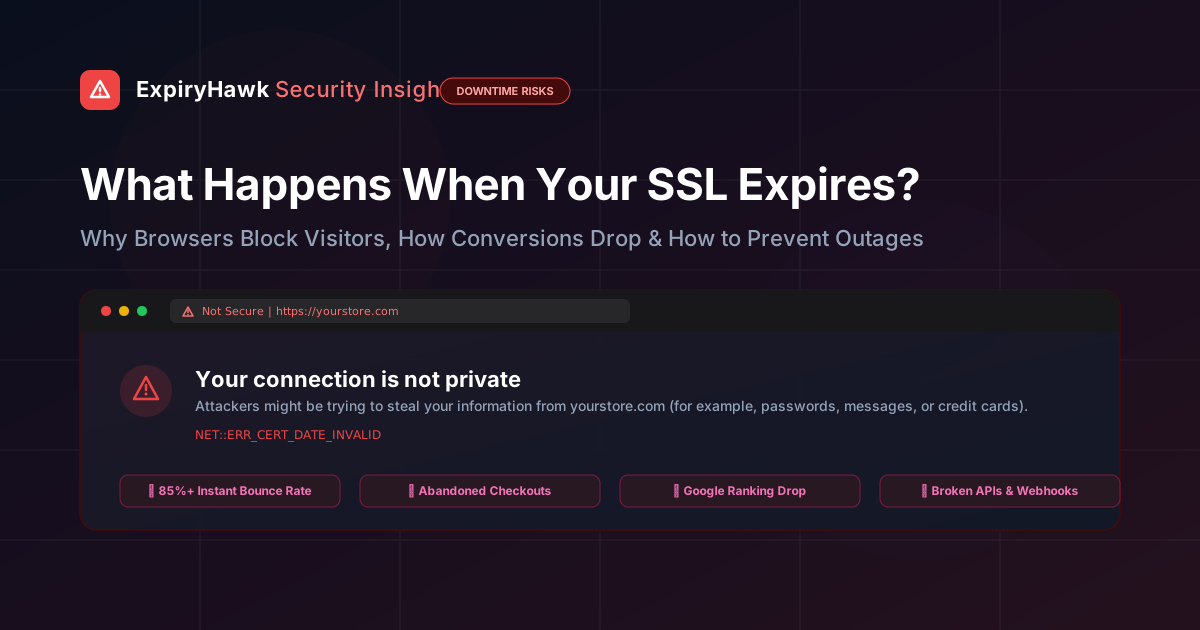
If Certbot fails silently at 3:00 AM on day 88 of a 90-day certificate, you have less than 48 hours to discover the failure before your site drops offline for all customers worldwide.
A 4-Step Action Plan to Prepare Your Infrastructure#
Here is how mature DevOps and security teams are preparing for the 90-day mandate:
Step 1: Complete an Asset Inventory#
You cannot protect what you do not track. Audit all certificates across your domains, subdomains, external APIs, and custom TCP ports (such as 8443 or mail servers).
Step 2: Implement ACME Issuance Everywhere#
Standardize on automated issuance protocols. Whether you utilize Let's Encrypt, ZeroSSL, or Google Trust Services, configure ACME clients with automated renewal triggers at the 30-day or 60-day mark.
Step 3: Implement Independent "Outer-Loop" Monitoring#
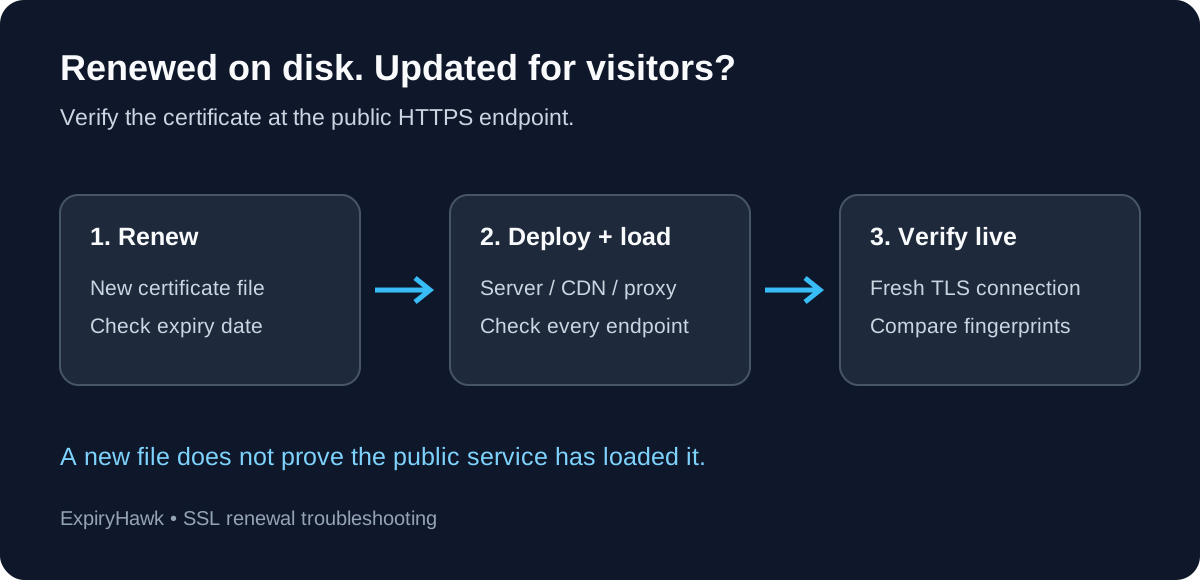
Never rely solely on your issuance agent to monitor itself. If your ACME client fails or your web server fails to reload the new certificate from disk after issuance, the internal agent might report success while the public web server is serving an expired certificate!
An external, independent monitoring service—like ExpiryHawk—performs continuous TLS handshakes from outside your network, verifying:
- Days remaining until expiration
- Complete intermediate CA certificate chain integrity
- OCSP stapling status
- Domain registration & WHOIS/RDAP expiration
Step 4: Multi-Channel Alert Routing#
Ensure expiration warnings are routed directly to where your engineers respond in real-time—such as Telegram channels, Slack/Discord webhooks, and urgent emails 30 days, 14 days, and 1 day before expiration.
Conclusion: Turning a Threat Into an Advantage#
Google's 90-day certificate validity proposal is not an impediment—it is an opportunity to eliminate technical debt. Organizations that embrace automated issuance combined with independent outer-loop monitoring will enjoy greater security, zero surprise expirations, and a resilient infrastructure.
Ready to safeguard your domains against certificate downtime? Get started with ExpiryHawk — monitor up to 20 domains with automated checks and instant Telegram & Webhook alerts, 100% free.