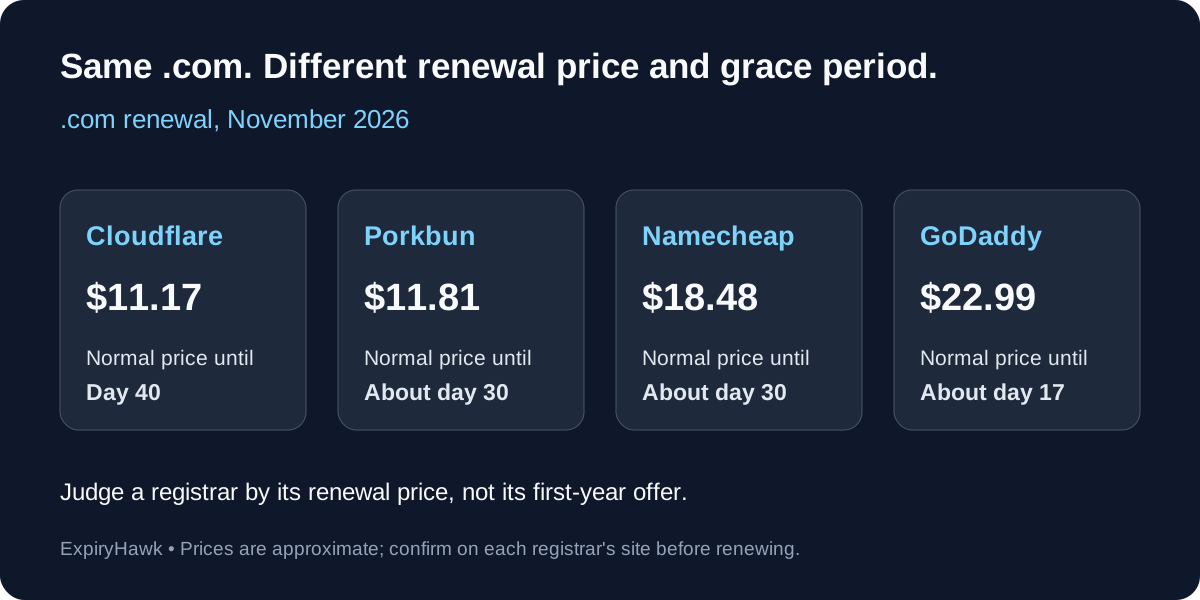
The best registrar for keeping a .com is the one with a low renewal price and a long grace period: after the November 2026 price rise, Cloudflare and Porkbun sit close to wholesale cost, while Namecheap and GoDaddy cost far more per year. Judge a registrar by its renewal price and by what it does when a renewal fails, not by its first-year offer.
1. The .com Price Just Went Up#
On 1 November 2026, Verisign, the registry that runs .com, raised its wholesale price from $10.26 to $10.97 per year, a 7% rise announced in April (Domain Name Wire). Its contract allows up to 7% more in each of the next three years, which could push the wholesale price to about $13.42 by the end of the cycle. Verisign has noted that registrars may charge any retail price they choose (DomainIncite).
Add ICANN’s $0.20 annual fee and the floor for a .com is now $11.17 a year (TLDES). Everything above that is registrar margin.
2. What a .com Costs to Keep#
| Registrar | Current .com price | Five years at that price* |
|---|---|---|
| Cloudflare | About $11.17/year, same for registration and renewal (at cost) | About $55.85 |
| Porkbun | About $11.81/year from 1 November, per Porkbun’s own notice | About $59.05 |
| Namecheap | Renewal tracked at $18.48/year in late 2026; no post-November price seen | About $92.40 |
| GoDaddy | Standard renewal list price $22.99/year | About $114.95 |
*Flat at today’s price, excluding first-year promotions and any further Verisign rises. Cloudflare’s figure follows from its at-cost model (Cloudflare) and was reported at $11.17 on 2 November (Snazzy). Porkbun’s comes from its knowledge base. Namecheap and GoDaddy figures come from price trackers (best-domain-registrars.com, Hostlist, citing GoDaddy’s price guide), so confirm at checkout. Some registrars list the ICANN fee separately.
Porkbun says it expects .com to keep rising by about 7% a year through 2030, and suggests renewing several years ahead (up to 10) to lock in today’s price.
3. What Happens When You Miss a Renewal#
ICANN sets the floor. Registrars must send renewal notices roughly a month and a week before expiry, and every .com gets a 30-day Redemption Grace Period after deletion in which it can be restored, usually at extra cost (ICANN). Beyond that, each registrar runs its own timeline.
| Cloudflare | Porkbun | Namecheap | GoDaddy | |
|---|---|---|---|---|
| Renew at normal price until | Day 40 | About day 30 | About day 30 | About day 17 |
| Site and email stop | Day 31 (suspension page) | After day 10 | At expiry | Day 5 (parked) |
| Third-party auction | Not described in docs | From about day 21–25 | Possible if not renewed | Listed from day 26 |
| Redemption (extra fee) | Days 41–70 | 30 days after deletion | 30 days, via support | From day 18 |
| Removed or released | Pending delete days 71–75 | Removed from account day 35–45 | Released about day 70–80 | Removed from account day 72 |
Sources
- Cloudflare Registrar FAQ
- Porkbun, expired domains
- Namecheap, TLD grace periods
- GoDaddy, standard domain expiration timeline
These timelines are for typical gTLDs such as .com. Country-code domains (.in, .io, .uk, .de and others) often follow different rules, so check yours.
Two details matter. At GoDaddy the free-renewal window is far shorter than at Cloudflare, and a domain with a pending auction bid can no longer be renewed. Porkbun’s auction rules work the same way. Redemption fees are not a fixed amount: they vary by registrar and extension, and ICANN requires registrars to publish them, so look up the number before you need it.
4. Registrar by Registrar#
Cloudflare Registrar sells at cost, so its price moves only when the registry’s does. The trade-off is control: domains registered there must use Cloudflare’s nameservers, and different ones require a transfer out (Cloudflare FAQ). It has the longest renewal window of the four, attempts auto-renewal about 30 days before expiry, and retries three more times before you must renew manually. Renewals are non-refundable.
Porkbun prices close to wholesale and announces increases in advance. Its first month is fairly generous, but auctions can begin before the renewal window closes, so waiting is a gamble.
Namecheap is known for cheap first-year promotions and a jump at renewal. Its expiry policy is reasonable: about 30 days at the regular rate, then a 30-day redemption stage handled through support, with the redemption price on a published table plus the $0.20 ICANN fee. Its own page warns that site and mail stop working the moment a domain expires.
GoDaddy is the biggest name and has the highest standard renewal price here. Its help center says it emails reminders within the 30 days before and after expiry, and retries auto-renewal on the day of expiry and again 12 days later. Its Ultimate Domain Protection add-on extends the no-extra-fee renewal window to 90 days. Without it, the domain leaves your account at day 72.
5. Transfer Rules to Know Before You Move#
These apply to most gTLDs regardless of registrar:
- ICANN blocks transfers within 60 days of a registrar change or a change to contact details, and a Change of Registrant approval can add its own 60-day lock (Cloudflare FAQ).
- A transfer normally adds one year. If you renew and then transfer within 45 days, the registry does not add the extra year, and you pay twice for the same period.
- The previous registrar has up to five days to release the domain.
Plan a transfer well before expiry, not during the grace period.
6. Other Registrars Worth Checking#
Hostinger’s policy page says .com domains registered through its provider get a 10-day renewal grace period, after which restoration depends on support (Hostinger). Name.com says long-expired domains may be removed from your account and may need a support ticket to recover (Name.com). Read the expiry policy before you commit to either.
Why Registrar Reminders Are Not Enough#
Every timeline above assumes you see the warning. In practice, reminders go to a single contact address that may belong to someone who left, sit in spam, or never be verified. Cloudflare’s FAQ describes the sharpest example: if the registrant email is unverified, ICANN rules require a hold, Cloudflare swaps your nameservers for parking ones, and the site stops resolving.
A grace period is a safety net, not a renewal strategy. The cheapest day to renew is always before expiry. Use ExpiryHawk to track expiry dates independently of your registrar’s emails, and confirm current prices and policies on each registrar’s own pages before you renew or transfer.