Multi-Port TLS & Certificate Monitoring for Hosting Infrastructure
Verify certificates across web, mail, file transfer, directory, and control panel ports from outside your network. Catch daemon reload stalls, OCSP stapling drops, and incomplete CA chains before customer tickets spike.
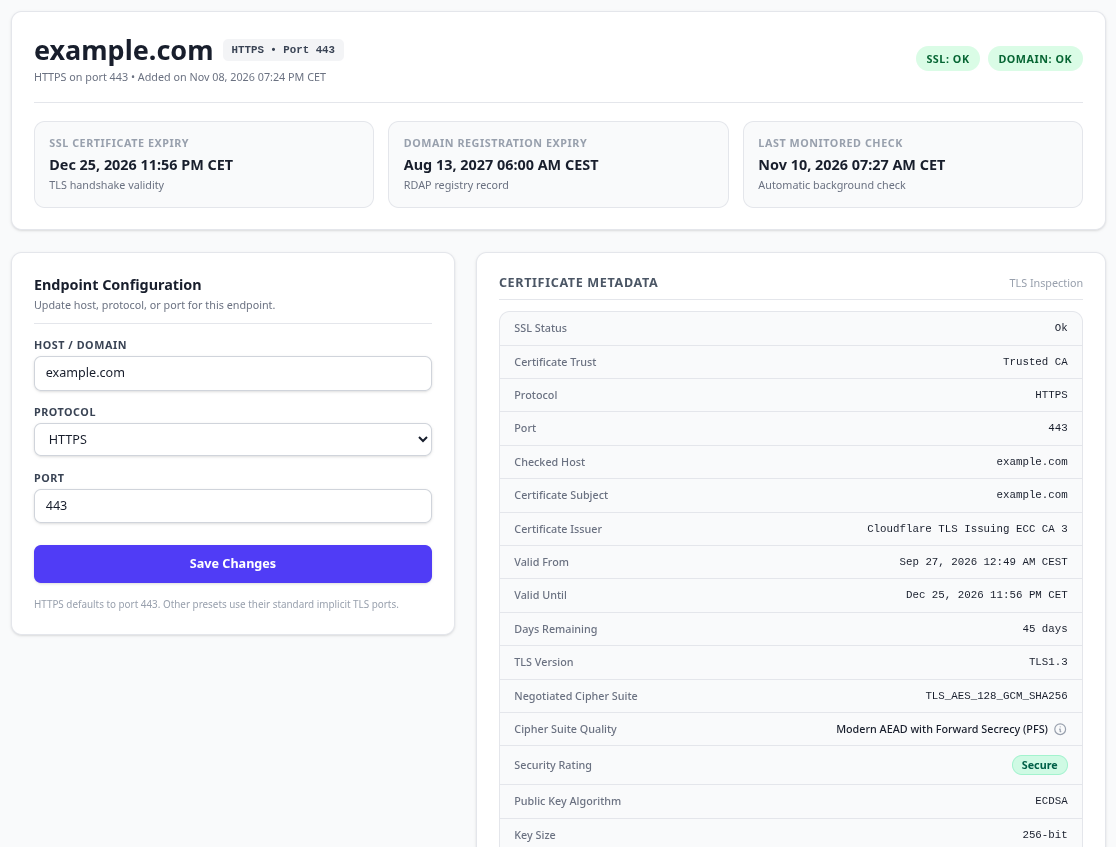
Native Protocol Presets & Multi-Port Coverage
Websites rarely run on port 443 alone. Hosting nodes expose customer email, FTP, LDAP, and admin panels on separate TLS listeners—and daemon reloads often leave mail or panel ports serving yesterday’s expired certificate.
| Protocol Preset | Default Port | Hosting Infrastructure Example |
|---|---|---|
| HTTPS | 443 | Shared web clusters, reverse proxies, customer storefronts, SNI vhosts |
| SMTP Implicit TLS (SMTPS) | 465 | Exim / Postfix authenticated submission endpoints |
| IMAPS | 993 | Dovecot / Courier encrypted client inbox retrieval |
| POP3S | 995 | Legacy mail client POP-over-TLS endpoints |
| FTPS | 990 | Pure-FTPd / vsftpd / ProFTPD implicit TLS file transfers |
| LDAPS | 636 | Directory auth and centralized customer identity servers |
| Custom TCP Ports | 1–65535 | cPanel (2083), WHM (2087), Plesk/DirectAdmin (8443, 2222), custom origin listeners |
mail.host.example:443, :465, and :993—independently. Read our guide on monitoring SMTP & IMAP certificates.
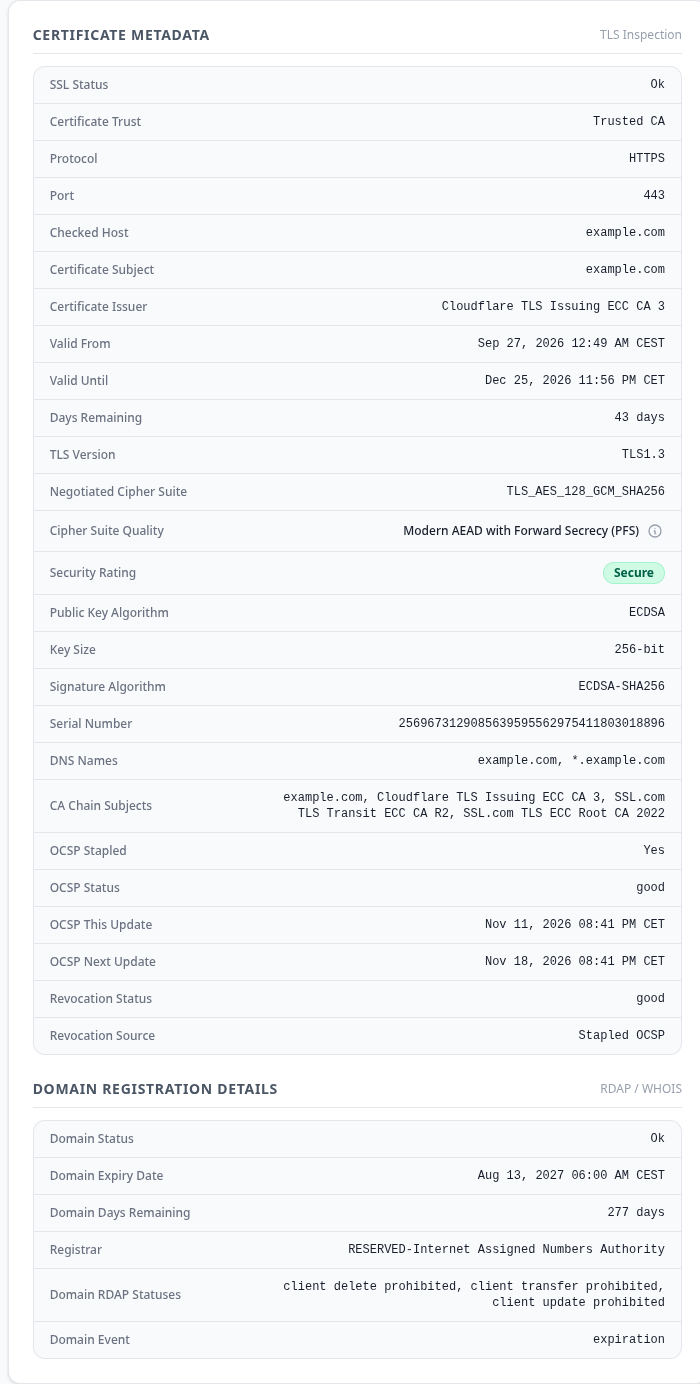
Verify OCSP Stapling, Intermediate CA Chains & Daemon Reloads
Installing or issuing an AutoSSL / Let’s Encrypt certificate on disk doesn’t prove edge clients see it:
-
Daemon Reload Drift: Detect when Apache reloads after certificate renewal while Dovecot (
:993) or Exim (:465) continues serving an old serial number. -
Intermediate CA & Root Transitions: Track
CA Chain Subjectsand spot broken intermediate bundles during root transitions (intermediate cert guide). -
OCSP Stapling Health: Inspect
OCSP Stapledstate andThis / Next Updatevalidity directly from public TLS handshakes. - Zero On-Server Agents: Works purely from an external network perspective across bare-metal nodes, load balancers, Cloudflare origins, and shared panels.
Why Hosting & Ops Teams Choose ExpiryHawk
Purpose-built external TLS, port, and RDAP verification without agent sprawl.
Monitor websites and mail services from an external perspective matching real customer TLS connections.
External SSL certificate monitoring for HTTPS, SMTPS, IMAPS, POP3S, FTPS, LDAPS, and control panels.
Domain expiry monitoring for supported TLDs via IANA RDAP with authoritative WHOIS fallback.
Dispatch automated expiry alerts to Slack, Discord, HMAC webhooks, Telegram, Email, or Browser Push.
Frequently Asked Questions for Hosting Providers
Can I monitor HTTPS, SMTPS, and IMAPS on the same hostname simultaneously?
Yes. ExpiryHawk stores uniqueness by host and port together, allowing mail.host.example to be monitored concurrently on 443, 465, 993, 995, and panel ports.
Does ExpiryHawk use direct implicit TLS or STARTTLS on mail ports?
ExpiryHawk uses direct implicit TLS handshakes on each configured port (including SMTPS 465, IMAPS 993, POP3S 995, FTPS 990, and LDAPS 636). Plaintext STARTTLS upgrades are not used.
Can I monitor control panel ports like cPanel 2083, WHM 2087, or Plesk 8443?
Yes. Enter any custom TCP port from 1 to 65535 when creating an endpoint monitor to inspect control panels and alternate TLS gateways externally.
Why verify OCSP stapling and full CA chains externally across hosting nodes?
Even when on-box certificates renew, mail or proxy daemons can hold expired certs in memory, or OCSP stapling can stall. External checks confirm the exact certificate chain and OCSP staple presented to clients over the internet.
Explore Other Solutions
Monitor your web, mail, and panel ports from the outside
Start with 20 free endpoints (scale up to 500 when ready) and automate multi-port TLS and chain audits.